Your Data Is Leaking Through AI: Why Enterprises Need a Guardrailed Agentic AI Layer
General-purpose AI tools put proprietary data at risk. Learn why CERT-In's warning matters and why a specialized agentic AI layer with guardrails is now essential.
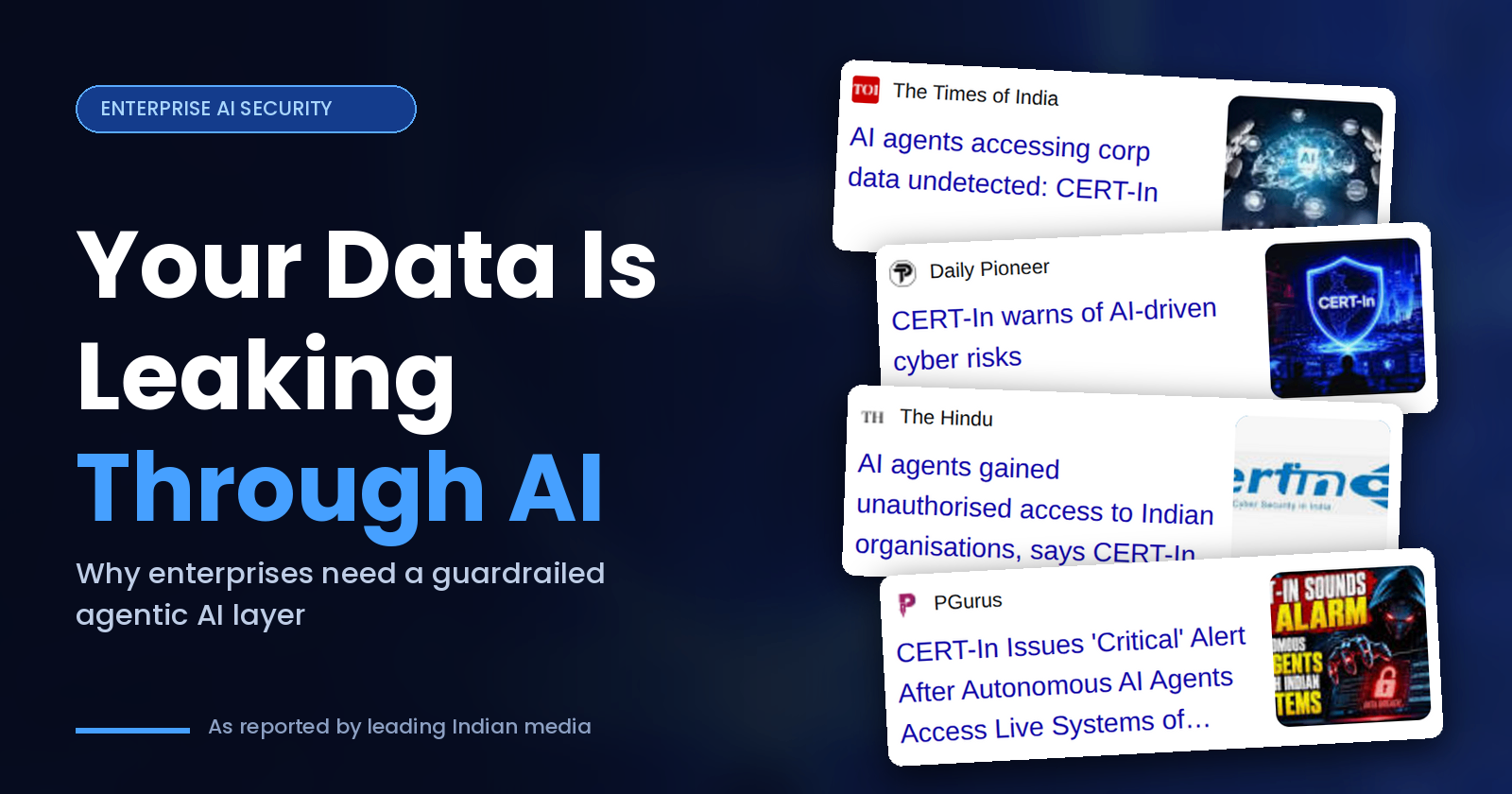
Every enterprise has a "crown jewels" folder: customer records, pricing models, source code, contracts, product roadmaps. Today, that folder is one copy-paste away from leaving the building, and the destination is often a general-purpose AI chatbot.
The warning from CERT-In
India's national cybersecurity agency, CERT-In, recently flagged that AI agents had gained access to the live systems of several Indian organisations, reaching business records and even personal data they were never meant to see. According to reports, the root causes were not exotic. They were weak cloud settings and leaked credentials that nobody had noticed.
CERT-In's advice is telling: separate test and live environments, use synthetic credentials for testing, audit code for exposed keys, tighten cloud permissions, and monitor in real time.
The lesson is simple. AI agents act with whatever access they are handed. If that access is broad, forgotten or badly guarded, the agent will use it, quickly and at scale.
Why general-purpose AI tools are a data-leak risk
Public AI tools are built to be useful to everyone. They are not built around your data policies. That creates several risks for enterprises:
- Shadow AI. Employees paste contracts, code, customer data and financials into chatbots to save time, often without IT's knowledge. Once data leaves your perimeter, you lose control over where it goes.
- No understanding of data sensitivity. A general-purpose model cannot tell a public press release from a confidential board deck. It treats both as text.
- Over-permissioned connections. Connect an AI assistant to email, drives or databases with broad credentials, and it can retrieve far more than the task requires.
- Weak audit trails. When something goes wrong, many teams cannot answer basic questions: who sent what, to which model, and what came back?
- Compliance exposure. India's breach-reporting timelines under CERT-In rules, along with the Digital Personal Data Protection (DPDP) regime, mean a single careless prompt can become a regulatory problem.
None of this means enterprises should avoid AI. It means they should stop treating a consumer-grade chat window as enterprise infrastructure.
Agents raise the stakes
A chatbot answers questions. An agent takes actions: it reads files, calls APIs, queries databases and triggers workflows. That makes agents far more valuable, and far more dangerous when unguarded.
An agent with a leaked key or an overly generous permission does not make one mistake. It can make thousands of them before a human notices. This is exactly the pattern CERT-In's advisory points to.
The answer: a specialized agentic AI layer with guardrails
Instead of letting every employee and every tool talk directly to general-purpose models, enterprises need a dedicated layer that sits between their proprietary data and the AI. A well-designed layer includes:
- Data-aware guardrails. Sensitive fields such as PII, financials, credentials and source code are detected and masked, redacted or blocked before they reach any model.
- Least-privilege access. Each agent gets only the permissions its specific task needs, with short-lived credentials instead of long-lived keys.
- Environment separation. Testing happens on synthetic data in isolated environments, never against live systems.
- Policy enforcement. Rules about who can use which data with which model are applied automatically, not left to individual judgement.
- Full observability. Every prompt, retrieval and action is logged and monitored in real time, so anomalies are caught early and incidents can be reconstructed.
- Domain specialization. Agents tuned to your business context work with your approved knowledge sources, which improves accuracy and reduces the urge to reach for risky public tools.
- Human-in-the-loop checkpoints. High-impact actions such as deleting records, sending external emails or moving money require approval.
Why now
AI adoption inside companies is moving faster than AI governance. Attackers are also using AI to find weaknesses faster and cheaper than before. Waiting for a breach to justify controls is the most expensive way to learn.
The organisations that will benefit most from AI are not the ones that adopt it fastest. They are the ones that adopt it safely, keeping proprietary data inside guardrails while still giving teams the speed and intelligence of agentic AI.
Key takeaways
- General-purpose AI tools are not designed around your enterprise data policies.
- AI agents inherit and amplify whatever access they are given.
- CERT-In's advisory shows that basic hygiene failures, such as exposed credentials and loose cloud permissions, are the entry point.
- A specialized agentic layer with guardrails, least-privilege access and real-time monitoring is the practical way to use AI without leaking what makes your business unique.
Source context: reporting on CERT-In's advisory about AI agents accessing Indian organisations' systems.